
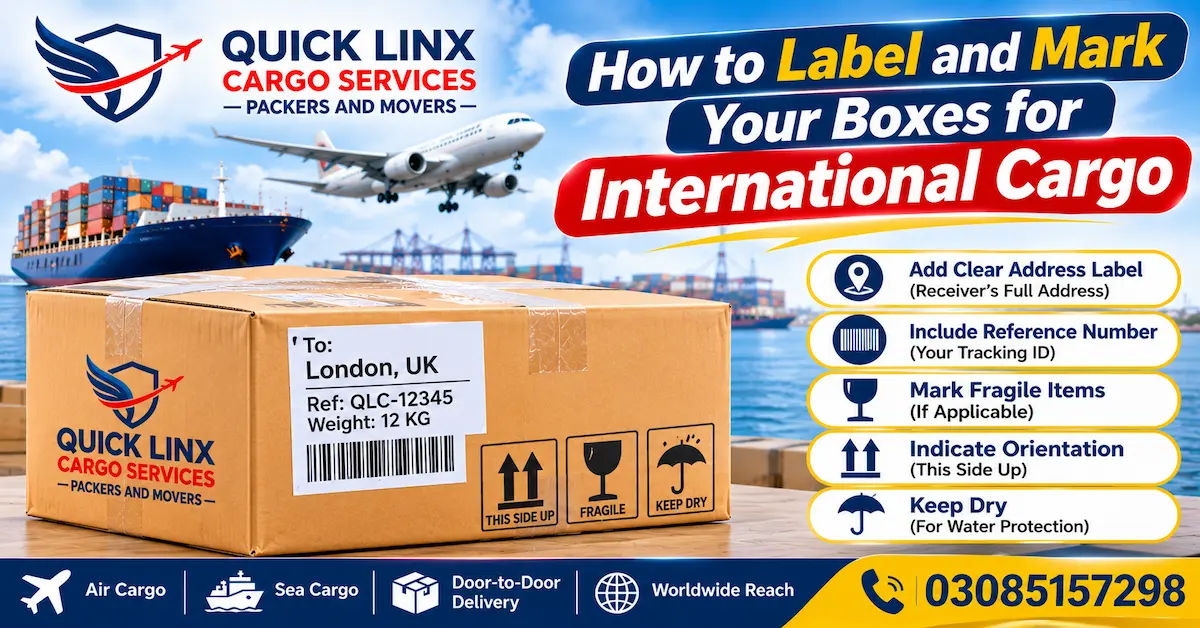
A box with a missing or unclear label can lose days in transit or end up at the wrong address. Labelling is a small job, but it decides how smoothly your cargo moves from pickup to delivery. After years of handling international cargo from Islamabad and Rawalpindi, Air Cargo QLC has seen how often a simple label mistake causes delays. This guide shows what to write on each box, where to place it, and which marks to add.
Why Correct Box Labels Matter for International Cargo
Your cargo passes through many hands before it reaches the receiver. Each handler needs to know whose box it is, where it is going and how to treat it. A clear label answers all three questions in seconds. A faded or incomplete label forces staff to stop and check. That costs time, and the box may be set aside while the rest of the shipment moves on.
Label and Mark: What Is the Difference?
A label is the sticker or paper slip that carries address details. A mark is anything written directly on the box, such as a box number, a destination or a handling symbol. Most shipments need both. The label identifies the sender and receiver. The marks show how many boxes belong together and how to carry them. Using both gives you a backup if one gets damaged.
What Can Go Wrong With Poor Labels
Weak labelling causes problems that are easy to avoid:
- Boxes get separated from the rest of the shipment
- Delivery is delayed while staff try to confirm the address
- The receiver cannot match boxes to the packing list
- Fragile items are handled roughly because nothing warns the handler
What Information to Write on Every Box
Every box needs the same core details. Keep the wording short and write in capital letters so it is easy to read. Use a permanent marker or a printed label, never a pencil or a light pen. Write the full address of the sender and receiver, including city, postal code and the destination country in capitals on the last line. Copy the receiver’s address exactly as it appears on your documents.
| Label Detail | What to Write | Why It Matters |
| Sender | Full name and mobile number | Lets handlers reach you if there is a problem |
| Receiver | Full name, address, postal code, country and phone | Needed for correct delivery |
| Box number | Format such as 1 of 5 | Shows if any box is missing |
| Contents | Short category, such as clothes or books | Helps match the box to your packing list |
| Handling mark | Fragile, This Side Up, Keep Dry | Warns handlers how to carry the box |
Sender and Receiver Details
Write the sender’s name and phone number in the top left corner. Write the receiver’s name, full address and phone number in the centre of the same side. Add the country code to the receiver’s phone number. Check the spelling of the street, area and city twice. Ask the receiver to confirm their address by message before you write it on the box. This one check prevents most delivery problems.
Box Numbers and Piece Count
Number every box as part of the total, for example 1 of 4, 2 of 4, 3 of 4 and 4 of 4. Write this on the top and on one side. Anyone can then count the boxes and spot a missing one straight away. The receiver can also tick them off against the packing list. Never use the same number on two boxes in one shipment.
Contents Description and Weight
Add a short contents description, such as clothes, books or kitchenware. Keep it general and honest, and make sure it matches your packing list. If you have weighed the box, write the gross weight in kilograms. Avoid writing the value of the goods on the outside of the box. Keep that detail on your invoice or packing list instead.
How to Label Boxes for Shipping Abroad, Step by Step
Good labels start with good preparation. Work through the steps below once each box is packed and sealed. Keep all boxes of one shipment together so you can number them in one go. Do this before pickup so you are not rushing when the team arrives.
- Seal the box fully with strong packing tape.
- Remove old labels and barcodes, or cover them completely.
- Choose a flat spot on the top of the box, away from seams and corners.
- Write or stick the receiver and sender details.
- Add the box number and a short contents category.
- Add handling marks on a side next to the address label.
- Cover paper labels with clear tape, but keep any barcode readable.
- Place a copy of the address slip inside the box.
Where to Place Labels
Put the main address label on the top of the box, on a flat area with no tape lines running through it. Repeat the box number and destination on one side. If the top label gets scuffed in a stack, the side mark still shows where the box belongs. Never wrap a label around a corner or edge, because the text becomes hard to read and scan.
Materials That Survive Handling
Your label will rub against other boxes, floors and trolleys. Use a thick permanent marker or a printed label with strong glue. Cover paper labels with clear tape so rain and rough handling cannot smudge them. For door-to-door delivery, the receiver’s address and phone number matter even more, because the final delivery depends on them. You can read about our door-to-door cargo service if you want delivery straight to the receiver.
Handling Marks and Warning Labels Your Boxes May Need
Handling marks tell staff how to treat a box. Without them, a fragile box can be stacked under a heavy one. Add only the marks that apply to your goods. Too many warnings on every box makes them easy to ignore. Place marks on a clear side, close to the address but never on top of it.
Fragile, This Side Up and Keep Dry
Use these three marks most often:
- Fragile: glass, ceramics, framed items and electronics
- This Side Up: items that can leak or break if tipped over
- Keep Dry: books, documents, clothes and paper goods
Write them in large letters or use a printed sticker. Pair a mark with proper packing inside the box. A fragile sticker cannot protect a poorly packed item.
Liquids, Batteries and Restricted Items
Some items need more than a simple mark. Liquids, perfumes, powders and batteries may need extra labels or paperwork, and some may not be allowed on certain routes. Tell our team what is inside before you pack. It is much easier to fix this before pickup than after the box is sealed and labelled.
Labelling Boxes for Air Cargo and Sea Cargo
The basic details stay the same for both. The main difference is the journey. Sea cargo boxes are often loaded with other shipments, so numbering and a clear destination are even more important. Check our air cargo services and LCL sea cargo services pages to choose the right option for your shipment.
| Labelling Point | Air Cargo | Sea Cargo (LCL) |
| Address label on top | Yes | Yes |
| Box number (1 of 5) | Yes | Yes, very important for shared containers |
| Waterproof protection | Recommended | Strongly recommended |
| Address slip inside box | Recommended | Strongly recommended |
| Weight on box | Helpful | Helpful |
Weight on the Label and Your Final Cost
Cargo charges depend mainly on weight and destination. Writing the weight on each box helps you check your own figures before booking. You can view approximate per KG rates on our Pricing page. Rates are approximate, so the final price is always confirmed with our team before you ship.
Matching Box Labels With Your Packing List and Documents
Your labels should tell the same story as your paperwork. If your packing list says five boxes, the labels should show 1 of 5 to 5 of 5. If the receiver name differs between the label and the documents, the box can be held for checks. Consistency is what keeps your shipment moving.
Keep One Master List
Write a simple list as you pack. For each box, note the number, the contents and the approximate weight. Use the same wording on the label and the list. Our guide on how to send air cargo from Islamabad explains the full booking process if you are shipping for the first time.
Take Photos Before Pickup
Take a clear photo of each labelled box before the team collects it. Keep the photos on your phone. If any box is questioned later, you can show exactly how it was marked. This takes only a few minutes and gives you a useful record for your own reference.
Common Box Labelling Mistakes to Avoid
Most labelling problems come from small habits. They are easy to fix once you know them. Check each box against this list before pickup:
- Using an old box with the previous address still visible
- Placing tape over the address or barcode
- Writing with a pen or marker that smudges
- Putting the address only on one side
- Leaving out the receiver’s phone number
- Numbering boxes differently from the packing list
- Writing the address differently from your documents
A Quick Check Before Pickup
Stand back and look at each box from one metre away. Can you read the address and the box number easily? If not, a handler in a busy warehouse will struggle too. Rewrite anything that looks faint, crowded or crooked. Two minutes of checking now can save days of delay later.
FAQs
Get Your Boxes Checked Before Pickup
Not sure how to mark boxes for your destination? Tell us the country and what is inside, and our team will guide you before pickup. Call 03085157298, email Info@aircargoqlc.com, or visit our Contact Us page to get started.